This article was first published on iklimriskleri.com and migrated with a July 2026 update.
For banks, physical climate risks are no longer a topic for the sustainability report; they are a matter of capital adequacy, collateral valuation, and loan pricing. Floods, droughts, storms, and heat waves feed straight into the balance sheet through probability of default (PD) and loss given default (LGD). And yet, across the industry, physical risks still largely remain at the level of “qualitative statements.”
The hidden trap: location turns into a cost of capital
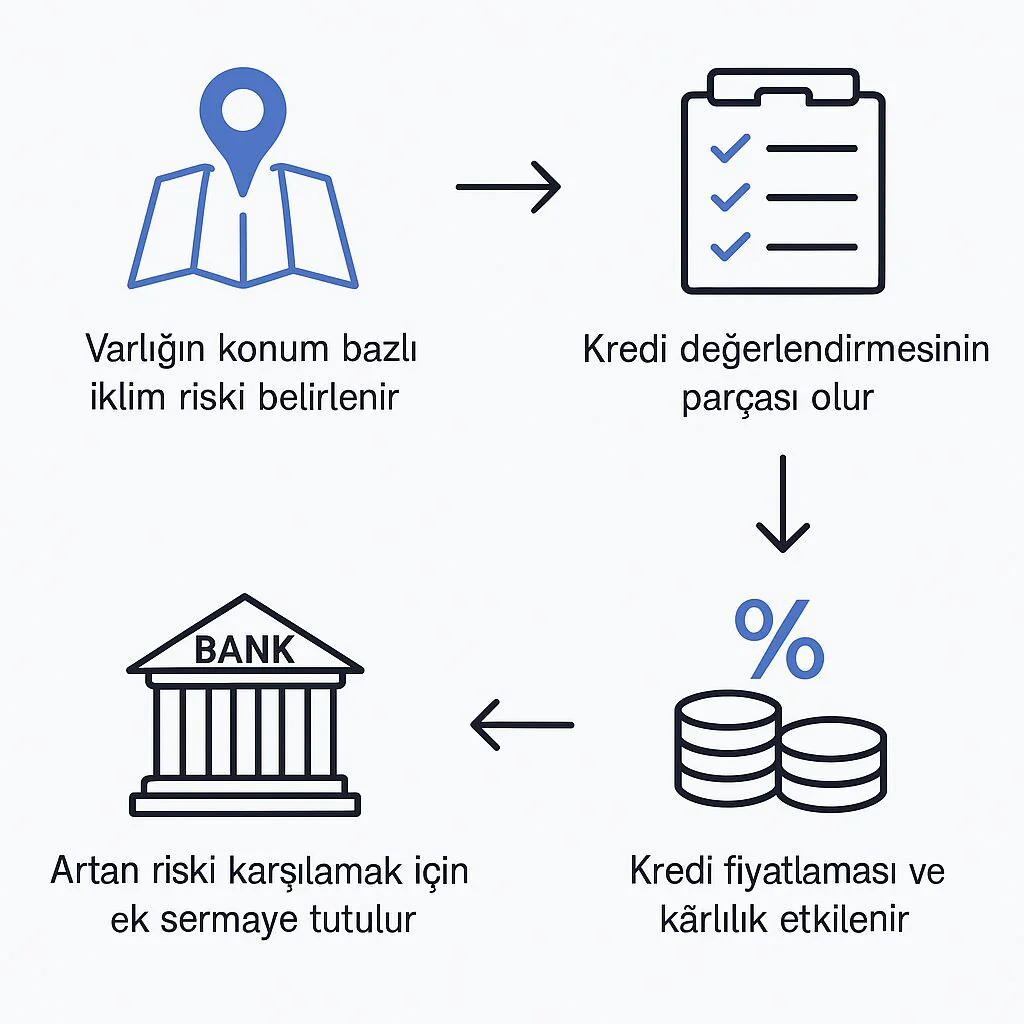
The mechanism is simple: a loan in a high-climate-risk area is assigned a higher probability of default (PD). That means higher risk-weighted assets (RWA), a larger capital requirement (higher CET1), and lower capital efficiency (a squeezed ROE): the bank extends less credit with the same capital. On the collateral side, real estate in a flood zone pushes LGD upward through value erosion and insurability problems; collateral concentrated in the same basin loses value simultaneously in a single event, invalidating the diversification assumption.
A simple example shows how a location-based risk score feeds into loan pricing:
| Asset Location | Flood Risk Score¹ | Estimated PD Increase | Capital Buffer Impact |
|---|---|---|---|
| A – Low-risk area | 10 / 100 | 1.2% → 1.2% | Neutral |
| B – High-risk area | 85 / 100 | 1.2% → 3.1% | +45% additional capital need |
1- Risk scores are hypothetical and shown for an arbitrary location and asset type. Under Basel III, a gap like this can move capital planning by as much as 10%. Location-based scores like the ones in this example can be produced for any address and hazard type with UrClimate Score.
The regulatory framework: from CRR3 to the BDDK guide
Article 449a of the Capital Requirements Regulation (CRR, EU No 575/2013) established that ESG risks “will now be treated as financial risks, beyond qualitative statements.” In Türkiye, the framework has taken shape quickly through the BDDK guide, the YVO (green asset ratio) Communiqué, and the Türkiye Sustainability Reporting Standards (TSRS); we lay out our view of the sector on our banking page.
| Regulation | Date | What it means for banks |
|---|---|---|
| CRR3 / Article 449a (EU) | January 1, 2025 | ESG disclosure obligations extended from large listed banks to all EU institutions |
| EBA final draft ITS (EBA/ITS/2026/02) | June 22, 2026 | First reference date: December 31, 2026 for large institutions, December 31, 2027 for small and non-complex institutions |
| BDDK Climate Risk Guide | Published March 13, 2025, in force July 1, 2025 | Identifying and measuring risks; stress tests and İSEDES (ICAAP) integration, short-, medium-, and long-term scenario analyses |
| YVO Communiqué (BDDK) | April 2025 | Reporting the green asset ratio to the BDDK starting with June 30, 2025 figures |
| TSRS (KGK) | Thresholds doubled in January 2026 | Banks in scope regardless of size; paragraph 19/2 requires disclosing the financial impact of asset-level risks |
The way forward: from location inputs to capital outputs
The impact has to be measured at the coordinates of the loan and its collateral (not with a provincial or district average) and the measurement has to be documented with a methodology that can be defended in front of an auditor. UrClimate Next fills this gap with SSP scenarios and location-based damage layers:
| Module | What does it do? | How does it make a difference? |
|---|---|---|
| Hazard Engine | Historical + forward-looking probabilities at 1 km resolution for flood, storm, heat wave, and more | Coordinate-level sensitivity, not province or district |
| Vulnerability | Sector-specific vulnerability coefficients (energy, agriculture, real estate…) | The PD/LGD multiplier is tied directly to the asset type |
| Impact-to-Capital | ICAAP/İSEDES-aligned RWA delta and capital buffer outputs | Capital impact in bps for board reports |
| API / SaaS | Web service or integration (KKB, core banking) | Fast rollout; we manage model versioning |
With a single line of code: send the loan’s address and sector code, and receive the updated PD-LGD output for the selected scenario within seconds. The payoff: a proactive buffer that simulates the RWA increase with roughly ±10 bps precision, risk-based pricing that passes the physical risk premium into the loan margin, an asset-level impact table that satisfies TSRS disclosures and the İSEDES scenario expectation, and auditor-ready model documentation.
Conclusion: put a number on climate risk
ESG reports may look “green” today, but once these risks land in the financial statements, late fixes can mean serious profit losses. It is time to move physical climate risks out of the “immaterial” bucket and turn them into a measurable capital metric. To request a demo simulation for your loan portfolio, reach us at info@alkazar.com.tr.
For the full chain from hazard to PD, LGD and expected credit loss, see our physical climate risk and financial impact page.
For the BDDK guidance, green asset ratio and green taxonomy dates, see our Türkiye climate regulation timeline.
The EBA timeline is final and the BDDK guide is in force: regulation is no longer coming, it has arrived. Are you ready?