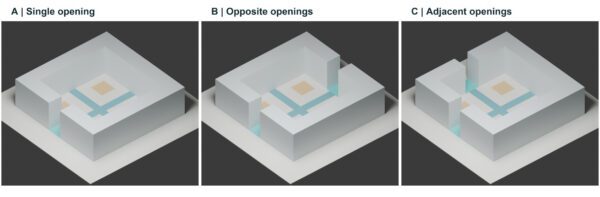
Where should courtyard openings be? How pedestrian-level wind changes with design
The position of courtyard openings affects seating areas and walkways differently. We examined how the ranking of the same layouts changes across two wind directions.


The position of courtyard openings affects seating areas and walkways differently. We examined how the ranking of the same layouts changes across two wind directions.
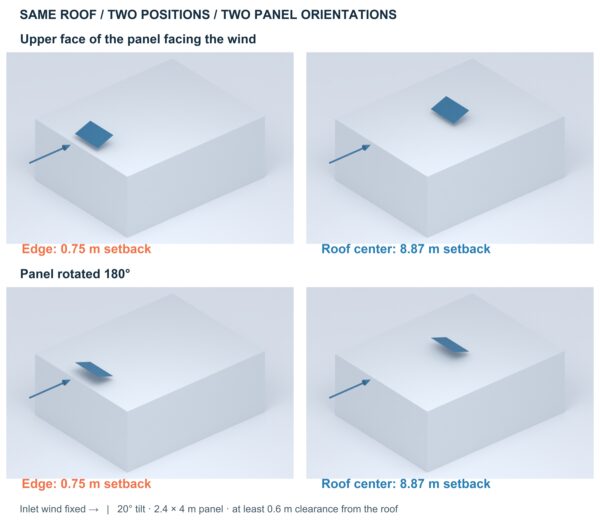
We compared the same solar panel at two roof positions and in two orientations. When position and orientation change together, the net effect can turn from uplift to downforce.
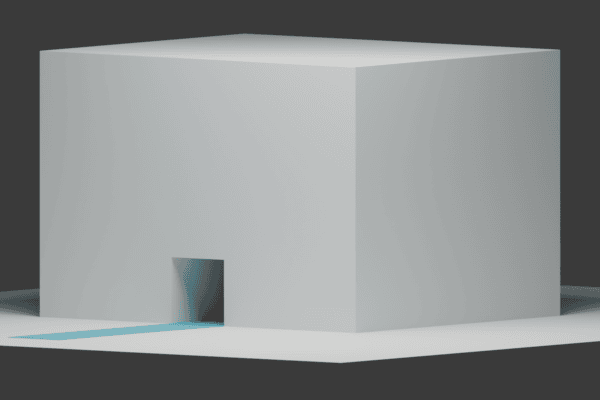
We compared a straight passage and passages with turns under a building. At the largest offset, the mean speed dropped by about 39%, but the fast regions around the turn remained.
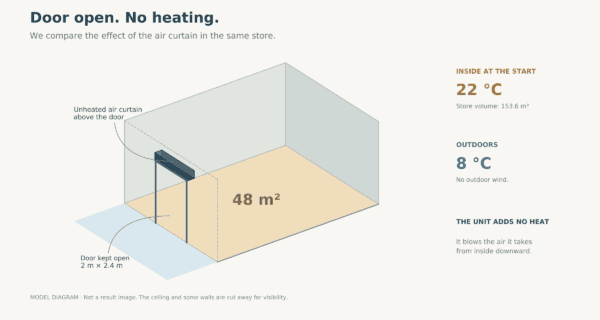
We compared the first three minutes in the same store with the air curtain off and running at three different flow rates. Stronger blowing did not give a better result in this example.
Data center cooling and airflow guide: ASHRAE envelope, CRAC/CRAH and liquid cooling, bypass and recirculation, condensation, N+1 redundancy, PUE and CFD.
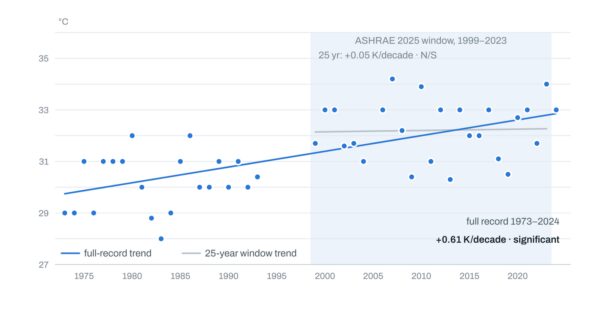
What do ASHRAE design conditions tell you, and what do they leave out? The short record window, the station-to-site gap and climate drift: three limits that quietly shape data center cooling capacity and the PUE business case.
A side-by-side comparison of how TSRS, IFRS S2 and the post-Omnibus CSRD treat physical climate risk, including Türkiye’s doubled 2026 thresholds and mandatory limited assurance.

How location-based physical climate risk feeds into PD, LGD, RWA, and capital for banks, with a sample simulation and the 2025-2027 BDDK and EBA timeline.
What Nordea’s net-zero 2050 targets, PCAF methodology, and ESG risk framework teach Turkish banks facing TSRS, the BDDK climate guide, and YVO reporting.

A 12-question checklist for screening physical climate risk providers, covering model transparency, uncertainty handling, assurance-readiness, and local backtesting against Türkiye’s recent events.

Türkiye’s 2025 fire season struck 53 provinces, and in 2026 flames reached an industrial zone in Torbalı. A guide to the fire-climate link, the numbers behind the seasons, and early warning.
Floods are becoming more frequent and more intense with climate change. From Rize-Artvin 2025 to Hatay 2026, we break down flood types, what the numbers show, and the role of location-based risk analysis.