

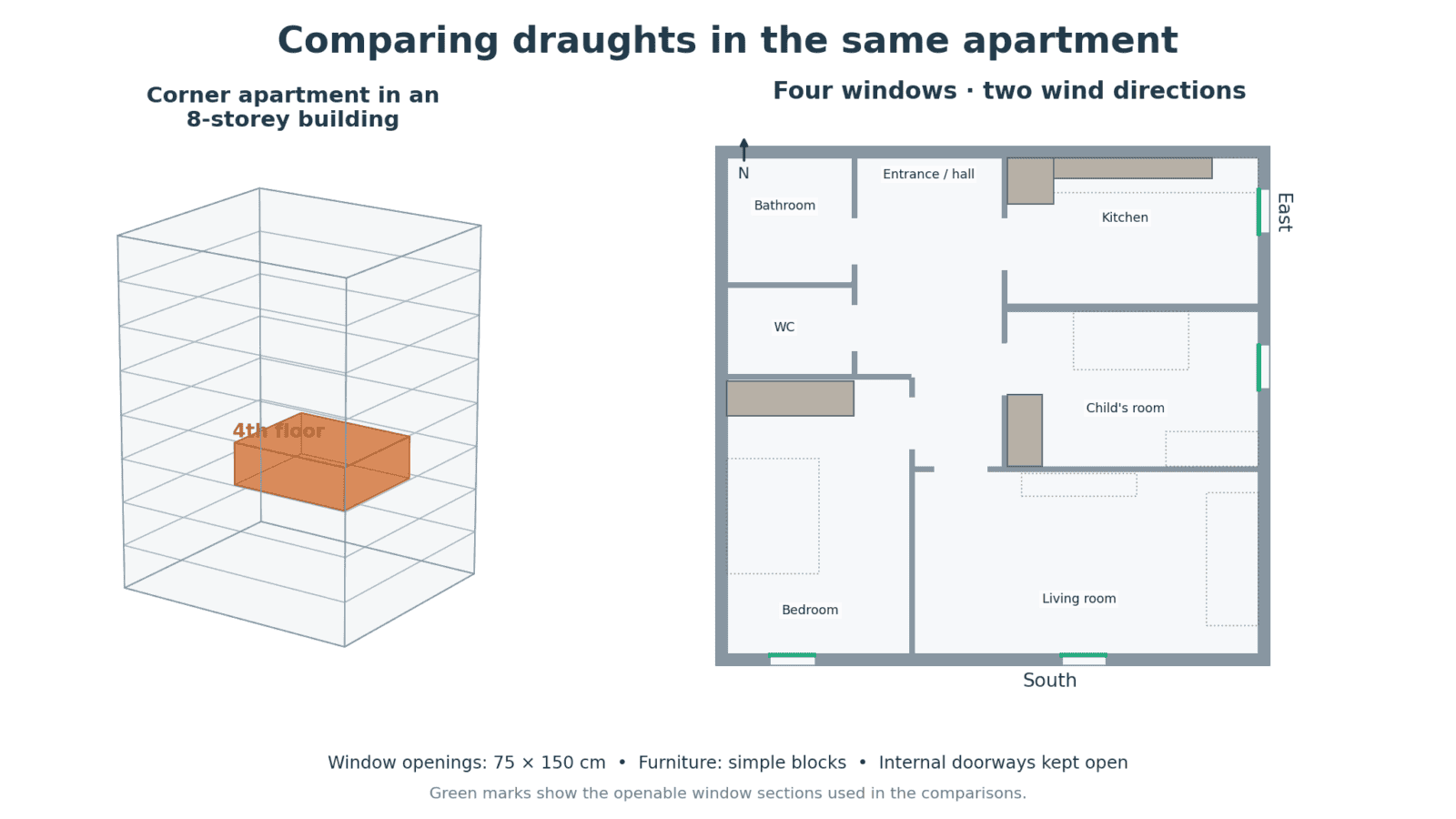
Air follows different routes through open windows and the passages between rooms in an apartment. In this study, we compare different window combinations in a corner apartment under southerly and easterly winds. We look at room air speeds alongside the amount of air passing through the windows to examine how the flow is distributed within the apartment.

Two and three open windows in the same home
In the apartment on the fourth floor of an eight-storey building, the living room and bedroom face south, while the kitchen and child’s room face east. The window openings measure 75 × 150 cm. Internal doorways are open, and large items of furniture are represented by simple blocks.
In the three-dimensional simulations, we applied wind from the south and east separately. The reference speed is 3 m/s at 10 m above ground; wind speed increases with height. In each comparison, we add one more open window on the other façade to the two that are already open.
To compare the faster-moving regions in each room, we use the room P95 air speed: the speed below which 95% of that room’s air volume falls. This is neither the maximum speed at a single point nor a sudden gust.
The kitchen becomes calmer while the living room speeds up
With a southerly wind and the living room and kitchen windows open, air enters through the living room and reaches the kitchen via the entrance hall. Opening the child’s room window creates a second outlet route.

In the kitchen, P95 falls from 1.02 → 0.61 m/s: a reduction of about 41%. At the same time, it rises in the living room from 1.29 → 1.48 m/s: an increase of about 15%.
The child’s room also joins the new airflow route; its P95 changes from 0.20 → 0.82 m/s. A window that reduces the fast-moving airflow in the kitchen can strengthen the airflow in the living room.
This time, the living room slows down while the kitchen speeds up
With an easterly wind and the kitchen and living room windows open, air enters through the kitchen and leaves through the living room. Opening the bedroom window creates a second outlet for the air.

The living room’s P95 changes from 1.02 → 0.83 m/s, a reduction of about 18%. In the kitchen, it changes from 1.76 → 1.98 m/s, an increase of about 12%. As the bedroom joins the new airflow route, its P95 rises from 0.06 → 0.40 m/s.
The P95 for the apartment as a whole remains almost unchanged in this comparison. If we had looked only at that value, we would have missed the decrease in the living room and the increase in the kitchen.
More air through the same inlet, two separate outlets
Opening a second outlet window creates another route for air to leave. Across the four comparisons examined, the total inflow rate increases by about 13–22%. At constant air density, this also means the mass flow rate increases by the same proportion. Because the inlet window’s dimensions remain unchanged, more air passes through the same opening; the inlet room’s P95 air speed also rises.
However, the total flow does not double, and it is now shared between two outlets. In these examples, the flow rate through the original single outlet window decreases; the P95 in the room containing that outlet also falls. The room with the newly opened window joins the airflow route.

In the living room–kitchen example under a southerly wind, net inflow rises from 1.95 → 2.34 kg/s, while the kitchen outflow falls from 1.95 → 0.91 kg/s. The new outlet in the child’s room carries 1.43 kg/s. The flow is not split equally between the two windows; façade pressures and the routes the air takes indoors jointly determine each outlet’s share.
Other window pairs also produce different responses in each room

With a southerly wind and the bedroom and kitchen windows open, opening the child’s room window reduces the kitchen P95 from 1.00 to 0.42 m/s. In the bedroom, P95 rises from 1.46 to 1.79 m/s.
A similar redistribution occurs with an easterly wind. With the child’s room and living room windows open, opening the bedroom window reduces the living room’s P95 while increasing it in the child’s room.
In both cases, the new outlet changes how air is distributed between rooms. Even as total inflow increases, speeds in some rooms can fall. This is why the total flow rate needs to be considered alongside room air speeds and airflow routes.
This study is for information only; design decisions require site-specific analysis. If you have any questions, please contact us.